Sajek Valley
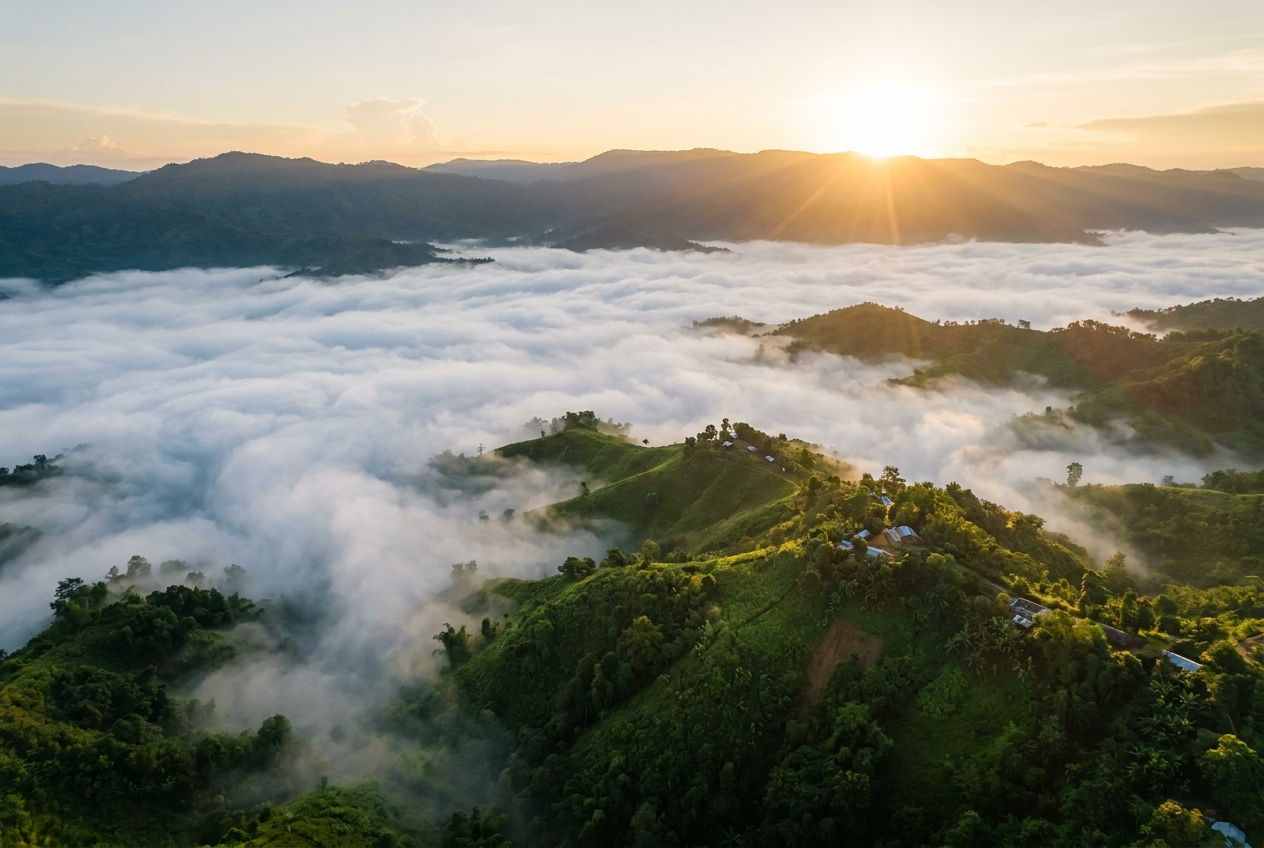
The kingdom of clouds
Sajek Valley is located in Rangamati, Chattogram Hill Tracts. A high hill valley where you wake above a sea of clouds, surrounded by green peaks and the warm hospitality of indigenous communities. The optimal visiting season is July to March with a recommended stay of 2 days.
Overview
Perched high in the Chattogram Hill Tracts at around 1,800 feet, Sajek Valley has earned its nicknames as the 'Queen of Hills' and the 'Kingdom of Clouds' in Bangladesh. On a good morning the valleys below fill with a rolling white sea of cloud, while the surrounding peaks float above it like islands.
The journey itself is part of the adventure — a winding drive through hills, usually in an open-top jeep (locally called a chander gari), past Lusai, Pankhua and Tripura villages. Although Sajek falls within Rangamati district, it is most easily reached from Khagrachari. At the top, rows of bamboo cottages line the ridge, each with a view that shifts by the hour, from misty dawn to fiery sunset to a sky thick with stars.
Despite being one of the most remote spots open to tourists, Sajek has developed a friendly little resort village with restaurants, viewpoints and helpful guides. The two main hamlets, Ruilui Para and Konglak Para, sit at either end of the ridge.
History & Culture
Sajek is named after the Sajek River, which forms part of the boundary with India's Mizoram state. The valley falls within the Rangamati district but is most easily reached from Khagrachari.
The area is home to indigenous communities — Lusai, Pankhua, Tripura and others — who have lived in these hills for generations. Tourism here is relatively recent, and visitors are asked to travel respectfully and in convoy for safety.
Top things to do in Sajek Valley
Watch sunrise over the clouds
Wake before dawn and head to the helipad or Konglak Hill to watch the valleys fill with cloud as the sun rises — the moment that gives Sajek its name.
Trek up Konglak Hill
A short, rewarding climb to the highest point of the ridge, passing a Lusai village and ending at a panorama over the surrounding hills and the Indian border.
Catch sunset at the helipad
The two helipads are the social heart of Sajek at dusk, with sweeping views as the sky turns orange and pink.
Ride the chander gari
The open-top 4x4 jeeps that carry visitors up the hills are an experience in themselves, winding through forest and villages.
Stargaze after dark
With almost no light pollution, Sajek Valley is one of the best places to stargaze in Bangladesh — bring a blanket, look up, and enjoy the brilliant blanket of stars.
Video Guide: Experience Sajek Valley
Watch cinematic 4K footage and essential visual travel highlights before planning your trip to Sajek Valley.
Sajek Valley in pictures


Photos via Wikimedia Commons under their respective Creative Commons licences. Click a photo credit for the source and full licence terms.
Highlights
- ✓Sea of clouds at sunrise
- ✓Konglak Hill — the highest viewpoint
- ✓Helipad sunset points
- ✓Indigenous Lusai & Tripura culture
- ✓Star-filled night skies
- ✓The scenic chander gari jeep ride
How to get to Sajek Valley
Although Sajek is in Rangamati, it is reached from Khagrachari town. Take an overnight bus from Dhaka to Khagrachari (about 9–10 hours), then a chander gari jeep or CNG for the 2–3 hour drive up to the valley.
Vehicles travel up to Sajek twice a day in an army-escorted convoy from Dighinala for safety. Plan your timing around the convoy schedule.
Best time to visit Sajek Valley
For the famous 'sea of clouds', the monsoon and post-monsoon months from July to October offer the best chances, when moisture fills the valleys at dawn.
The cool, dry winter from November to February has the clearest skies, the most comfortable weather and the best star-gazing, though fewer low clouds.
Avoid the hottest pre-monsoon weeks if you can, and always check that the area is open to tourists before travelling.
Where to stay
Sajek has dozens of bamboo cottages and resorts spread across Ruilui Para, ranging from simple rooms to comfortable hillside lodges with valley views. Book ahead in peak season and during holidays, as the best ridge-view cottages fill quickly.
What to eat
- 🍽️Bamboo chicken — chicken cooked inside a bamboo tube
- 🍽️Fresh hill-grown fruit and vegetables
- 🍽️Simple home-style meals served at the cottages
Travel tips
- 💡Carry enough cash; there are no ATMs in the valley.
- 💡Electricity and mobile signal can be limited — solar power and patchy networks are normal.
- 💡Respect indigenous communities: ask before photographing people and dress modestly.
- 💡Travel with the convoy and a local guide, and confirm the area is open before you go.
Nearby Attractions
The gateway town, with the Alutila Cave, Risang Waterfall and tribal markets worth a stop on the way.
A lakeside district known for Kaptai Lake, hanging bridges and boat rides, a few hours away.
Frequently Asked Questions
Why is Sajek Valley called the kingdom of clouds?+
Sajek sits high in the Chattogram Hill Tracts, and on many mornings the surrounding valleys fill with a sea of low cloud that you look down on from the ridge — earning it the nicknames 'Kingdom of Clouds' and 'Queen of Hills'.
How do you get to Sajek Valley?+
Although Sajek lies in Rangamati district, it is reached from Khagrachari town. From there, an open-top chander gari jeep takes you up to the valley in an army-escorted convoy for safety.
What is the best time to visit Sajek Valley?+
For the sea of clouds, visit between July and October. For clear skies, comfortable weather and the best star-gazing, the winter months of November to February are ideal.
Is Sajek Valley safe for tourists?+
Yes, when you follow the rules: travel up with the scheduled convoy, use a local guide, respect indigenous communities, and check in advance that the area is open to visitors.
Related Destinations & Travel Guides
Explore 5 interlinked destinations in Rangamati, Chattogram Hill Tracts& surrounding regions

A breathtaking river journey winding through deep gorges, towering rock cliffs, and remote indigenous villages in the untamed hills.

Crystal-clear river water rolling boulders down from the Khasi hills, set against the green peaks of the Indian border — the scenic gem of Sylhet.

A tranquil hill district built around the vast blue Kaptai Lake, with hanging bridges, Buddhist temples and the cultures of a dozen indigenous peoples.

Alutila Cave is a vast limestone cavern north of Khagrachari town, offering narrow tunnels, tall chambers and a sunlit exit in the heart of the Chittagong Hill Tracts.

One of the highest accessible peaks in Bangladesh, offering dramatic views of zigzagging roads, tribal villages, and endless rolling hills.